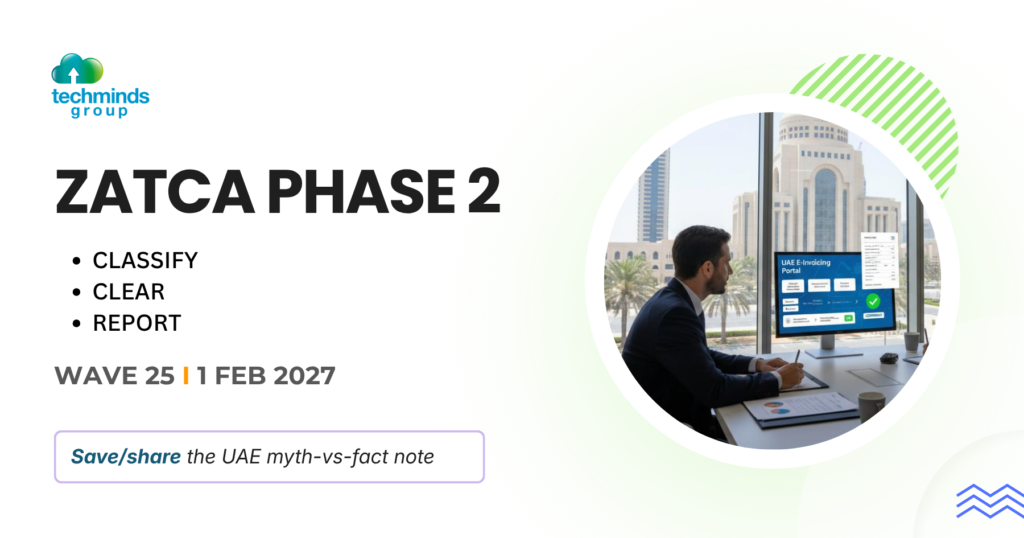
On 24 July 2026, ZATCA announced Wave 25 of the Phase 2 Integration rollout. The threshold is now businesses whose VAT-subject revenue exceeded SAR 187,500 in any of 2022, 2023, 2024 or 2025, with integration required by 1 February 2027.
The significance is not just the lower threshold. Wave 25 reaches a much broader population of companies whose finance systems may be perfectly adequate for day-to-day accounting but were not designed for continuous e-invoicing integration.
Phase 2 changes the operating model. Standard B2B/B2G invoices use the clearance flow, while simplified B2C invoices are reported under a different process. The ERP or integration layer must classify the transaction correctly, generate the required structured data and manage the response from Fatoora without creating manual bottlenecks.
For a smaller business, the wrong reaction is to assume compliance requires a major ERP replacement. Often it does not. If the current system can expose reliable invoice data, a focused integration or middleware layer can bridge the system to the compliance process. The larger work may be data cleanup: VAT numbers, invoice types, tax treatment, customer records and exception handling.
The practical question for Wave 25 is therefore not “which software is ZATCA-approved?” It is “can our current invoicing process reliably produce, submit and reconcile the required transaction data under the correct flow?”
That is the question Techminds uses to structure a Wave 25 readiness assessment before recommending a platform or connector.