
for e-invoicing. This makes UAE ASP selection a mandatory commercial decision, but the cheapest provider does not necessarily guarantee the lowest overall implementation cost.
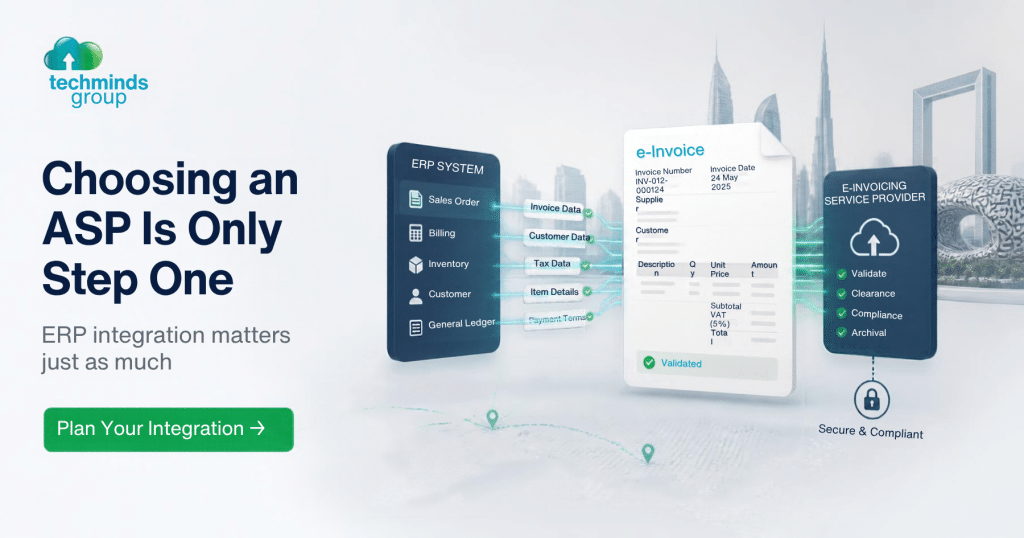
The first procurement consideration should be ERP integration compatibility. Businesses should evaluate the available interfaces, how acknowledgements and validation failures are communicated, and what testing environments are provided. It is also important to assess how well the provider supports the company’s ERP system, invoice volume, buyer network, and business hours.
The second question is operational resilience. What happens when the ASP, the Peppol exchange or an interface is temporarily unavailable? Is there queueing and retry logic? How are incidents reported? What service levels apply to production problems close to month-end or high-volume billing periods?
The third is data responsibility. The ASP performs important validation, conversion and transmission functions, but the business retains its compliance obligation. Procurement should understand what the provider validates versus what remains the ERP implementation partner’s or client’s responsibility.
The fourth is commercial transparency. Separate onboarding, implementation, subscription and transaction-based costs so the three-year operating model is visible before go-live.
Finally, evaluate the ecosystem around the ASP. A strong provider still needs a strong ERP integration. If the client’s ERP partner and ASP work as two disconnected vendors, issue ownership becomes ambiguous exactly when a rejected invoice needs fast resolution.
Techminds recommends selecting the ASP and designing the ERP integration as one coordinated workstream, while preserving clear contractual responsibilities for each party.
For omni-channel operators, the cleanest design is usually to centralize the decision at the ERP or transaction hub rather than hard-code compliance logic separately in every storefront or POS. The channel submits the transaction; the central system determines the buyer type, tax treatment and compliance path.
That architecture creates a clearer audit trail and avoids a future rewrite if the regulatory scope evolves.