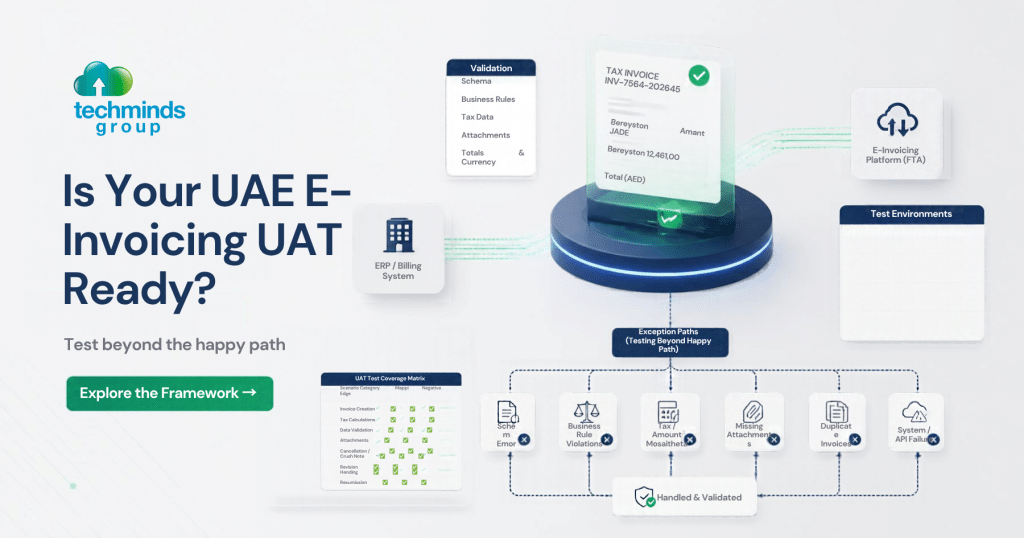
A successful “hello world” invoice is not a UAT plan.
UAE e-invoicing testing should reflect the real transaction population. That means multiple legal entities, customer types, tax treatments, currencies where applicable, discounts, charges, partial deliveries, credit notes and unusual commercial scenarios — not just one clean standard invoice.
Start by building a transaction catalogue with finance. Identify the high-volume patterns and the low-volume but high-risk edge cases. Map each to the PINT-AE data requirements and the expected acknowledgement path through the ASP network.
Then test three things independently. First, correctness: does the source ERP produce the right commercial and tax data? Second, transformation: does the mapping produce a valid structured electronic invoice? Third, operations: can the team see a failure, understand why it failed, correct the underlying issue and resubmit without breaking the audit trail?
Volume testing matters too. A distributor that produces thousands of invoices cannot validate production readiness with ten samples. Batch peaks, month-end runs and integration queue behavior should be understood before go-live.
Finally, UAT needs business ownership. IT can prove an API call works, but finance must validate amounts, tax treatment, customer data, credit-note behavior and the exception process.
The objective of UAT is not to demonstrate that the technology can send an invoice. It is to demonstrate that the business can operate the e-invoicing process when transactions are normal — and when they are not.